Getting Started with Pieces Desktop | Onboarding Guide
Get up and running with the Pieces Desktop App with this guided LTM + Conversational Search onboarding experience.
Signing In
When you first launch the Pieces Desktop App, you'll be prompted to sign in with GitHub, Google, or other authentication providers. Signing in enables you to store snippets and backups in Pieces Cloud and import code Gists. Pieces stores materials locally by default, and you can share them with anyone you'd like.
Login page showing sign-in options including GitHub, Google, and other authentication providers
Setting Up Preferences
After signing in, configure your initial preferences including theme mode and data sharing settings. These settings help personalize your Pieces experience.
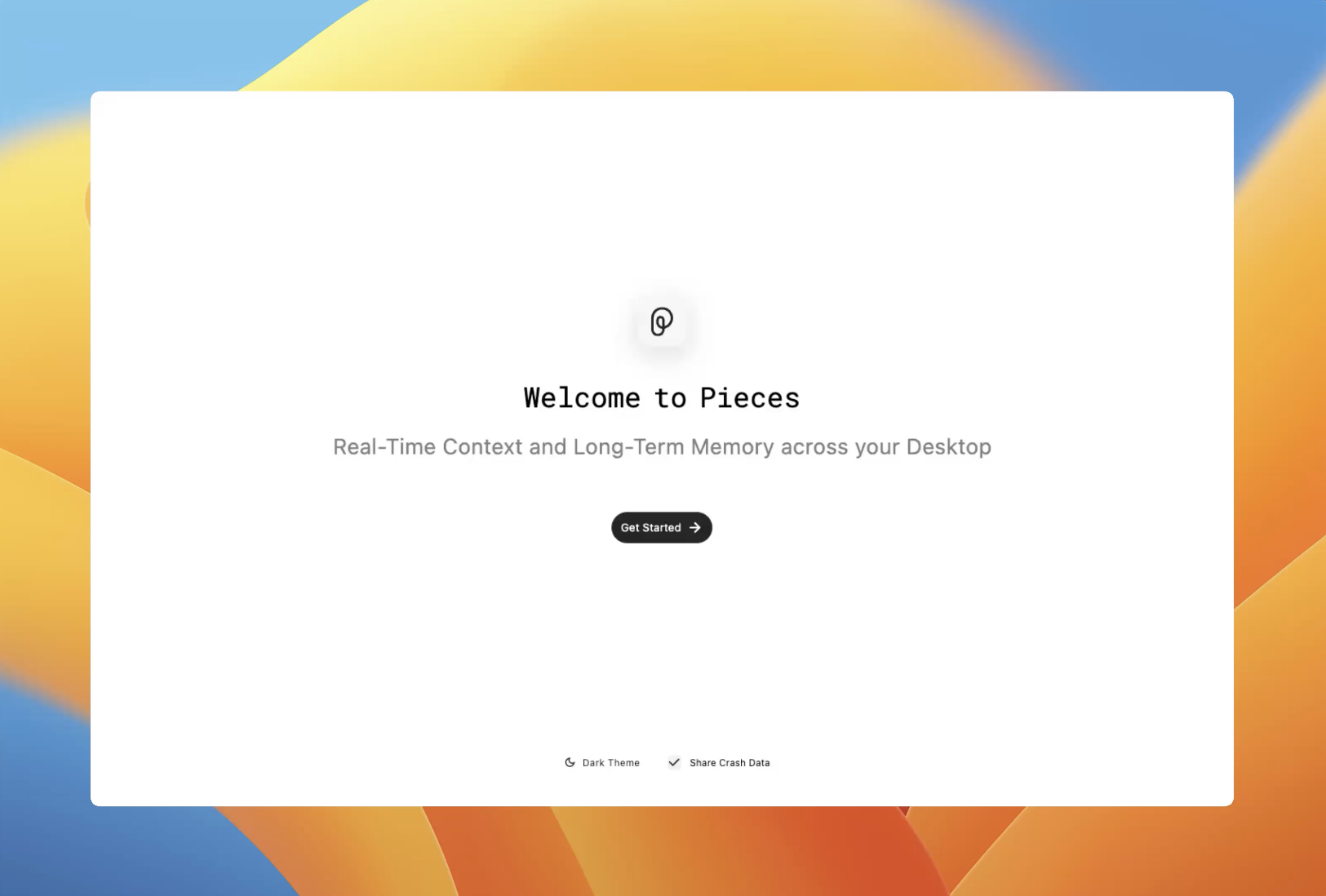
Theme selection screen showing Light and Dark theme options, anonymous crash data toggle, and Get Started button
Initial Memory Formation
After clicking Get Started, you'll land on the homepage of the Pieces Desktop App. The Long-Term Memory (LTM-2.7) Engine needs to capture workflow context before you can use all features. You'll see the Single-Click Summaries section with six cards that are locked until memory formation completes.
The homepage displays the Single-Click Summaries section with six cards: What's Top of Mind, Standup Update, Time Breakdown, Custom Summary, Day Recap, and Discover. These cards are grayed out and locked until memory formation completes. Below this section, you'll see the Forming Initial Memories progress tracker showing how many of the 30 required memories have been captured.
Understanding the LTM Welcome Screen
When you first arrive at the homepage, you'll see the LTM welcome screen that explains Long-Term Memory and its benefits. This screen introduces you to how Pieces captures and uses your workflow context to provide personalized AI assistance.

LTM welcome screen explaining Long-Term Memory and its benefits
Creating Initial Memories
After clicking Got It on the LTM welcome screen, you'll see the initial memory formation interface. This screen shows the progress of memory formation and introduces you to Single-Click Summaries that will become available once memories are captured.

Initial memory formation screen showing progress tracker, memory formation status, and Single-Click Summary cards
Capturing Workflow Context
Continue with your normal workflow for 10-15 minutes while LTM-2.7 captures workflow context in the background. The progress tracker shows memory formation status, and you can see which memories have been formed as you work. Each memory appears with a checkmark and description once it's been captured.
Unlocking Features
Once you've successfully captured 30 memories, the six Single-Click Summaries cards become clickable and unlock. You can now generate summaries like Standup Update, Day Recap, What's Top of Mind, and more. Each card provides one-click access to contextual summaries based on your captured workflow data, giving you instant insights into your productivity and work patterns.

Pieces Timeline showing unlocked Single-Click Summary cards and workflow events
Using Conversational Search
LTM captures and stores workflow context, enabling you to use Conversational Search as an AI assistant trained on your personal workflow data. All data is kept on-device for privacy, so your conversations and memories stay secure.
Understanding Conversational Search
Conversational Search lets you ask questions about your workflow and get context-aware responses powered by LTM-2.7. You can visit sites like Stack Overflow, read code explanations, and later query Conversational Search about what you read. By enabling LTM, you can use Conversational Search as an AI assistant trained on your personal workflow data, making it uniquely helpful for your specific work patterns and projects.

Conversational Search interface showing model selection dropdown and available models
Accessing Conversational Search
Access Conversational Search directly from the homepage to ask questions about your workflow, with LTM providing context from your captured memories. Switch models from the chat model selector.

Typing a prompt into Conversational Search input field
Next Steps
You've completed the Pieces onboarding and are ready to start exploring the app. Learn more about key features and how to utilize the Pieces ecosystem in your daily workflow.
Explore Key Features
Conversational Search - Ask questions about your workflow, get context-aware responses, and receive insights powered by LTM-2.7—all in a chat format you know.
Pieces Timeline - View incremental workflow summaries, saved context, and related information gathered by the Long-Term Memory (LTM-2.7) Engine.
Single-Click Summaries - Generate instant, contextual summaries from your workflow using preset summary types.
Customize Your Experience
Configuration - Customize everything from visuals and aesthetics to Conversational Search models to fit your preferences and workflow.
Navigation - Learn the different views and layouts in the Pieces Desktop App.
Actions & Keyboard Shortcuts - Use Power Menu Actions and Keyboard Shortcuts to perform tasks or navigate from view to view quickly.
Get Help
- Troubleshooting - If the Pieces Desktop App isn't working as expected, start here. This page explains our troubleshooting documentation and guides you to the solution that best addresses your issue.